
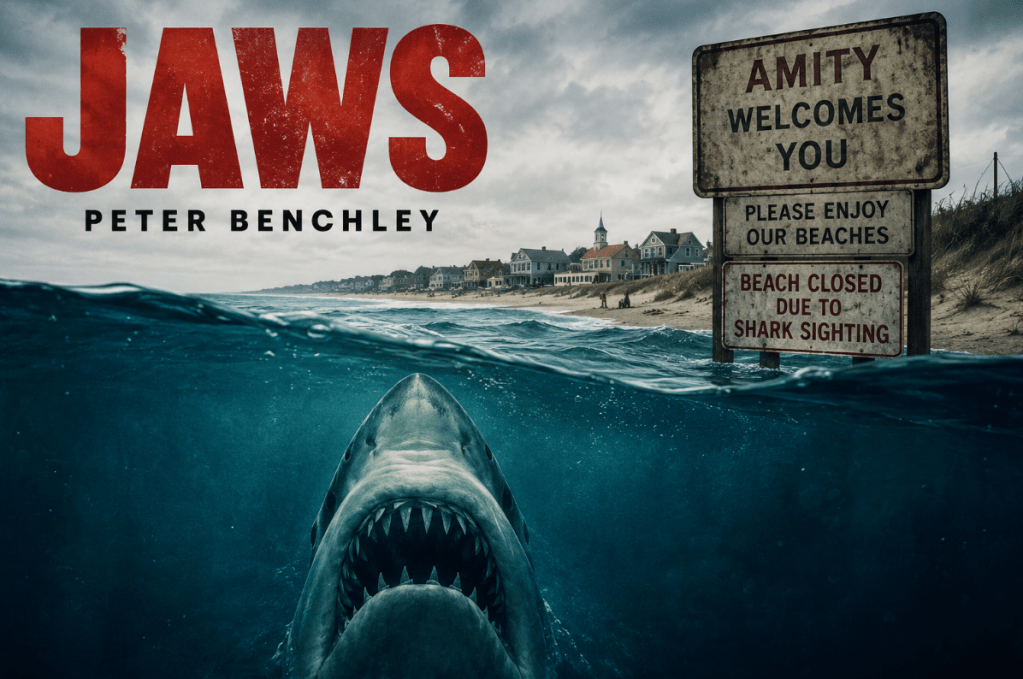
⭐☆☆☆☆ (1/5 Stars)
I never thought I’d say this about one of the most iconic thrillers ever written, but Jaws was one of the most disappointing books I’ve read in a long time.
Like many readers, I went into this expecting a tense survival story about a great white shark terrorizing a small beach town. Instead, I got an unfocused novel filled with unlikeable characters, unnecessary subplots, awkward dialogue, and one of the most anticlimactic endings I’ve ever read.
The biggest problem?
The shark is barely in its own book.
Benchley starts with an incredible opening. The first attack immediately hooks you, and for a moment it even feels like the shark might become one of the story’s central characters. Then the shark disappears for long stretches while the novel shifts its attention almost entirely to the personal lives of the townspeople.
Rather than building suspense, we’re given endless pages about Chief Brody’s unhappy marriage, Ellen Brody’s affair with Matt Hooper, social status, jealousy, and family drama. None of it made me care more about the characters, and almost none of it made the shark attacks more terrifying. In fact, every time the story finally returned to the shark, I found myself wishing it would hurry up and eat everyone so we could move on.
Unfortunately, the characters didn’t help.
Chief Brody is surprisingly difficult to like. Ellen Brody spends much of the novel dwelling on her dissatisfaction with her life and marriage. Matt Hooper is arrogant and creepy rather than charismatic. Even Mayor Vaughn’s motivations become so overcomplicated that they feel almost ridiculous.
Instead of rooting for anyone, I found myself rooting for the shark.
What surprised me most wasn’t just how boring the novel became, it was how uncomfortable parts of it were to read. The book is filled with misogynistic attitudes, objectifying descriptions of women, discussions of sexual fantasies that add absolutely nothing to the story, and racial stereotypes that have aged incredibly poorly. Rather than serving the narrative, these moments repeatedly pulled me out of it and made me question why they were included at all.
The dialogue doesn’t help either. Conversations often feel stiff, unnatural, and painfully long. Entire scenes exist that could be removed without affecting the story in the slightest, making the novel feel bloated despite its relatively short length.
Then there’s the ending.
After hundreds of pages building toward the final confrontation, the climax simply fizzles out. The shark’s death feels abrupt and strangely unemotional, and the novel ends almost immediately afterward without giving readers any real sense of closure. I actually flipped back a page because I thought I had accidentally skipped something.
I hadn’t.
To Peter Benchley’s credit, the novel does capture the fear of a small tourist town choosing money over public safety. That conflict still feels relevant decades later. But one interesting idea isn’t enough to save a novel that spends most of its time focused on storylines I couldn’t have cared less about.
This is one of those rare cases where the film isn’t just better than the source material, it fixes nearly every problem the novel has. Spielberg understood exactly what audiences wanted: the shark, the suspense, and characters worth rooting for. The movie strips away almost everything that weighs the novel down and turns a mediocre book into one of the greatest thrillers ever made.
If you’ve never read Jaws, my recommendation is simple:
Watch the movie. Skip the book.
Final Rating: ⭐☆☆☆☆ (1/5)


Leave a comment